What 20 years in BBC newsrooms teaches you about business podcasting


Podcasters should learn a lot from radio
Just recently, a potential client told us: "Anyone can make a podcast now. Why should we pay a premium for professional production?"
It's a fair question. Recording equipment is cheap. Editing software is accessible. Distribution is low cost.
But here's what 20 combined years in BBC newsrooms taught us: the equipment is the easy part. The craft is what separates noise from something people actually want to listen to.
The Jeremy Vine Show: 7 million listeners and what they taught me
I learned a lot working as a producer on the Jeremy Vine show on BBC Radio 2.
The Vine show reaches 7 million people every week. The podcasts we produce for clients reach 500-8,000. But here's what both need: broadcast discipline that holds attention from the first second.
Traditional broadcasting institutions understand what really matters. Engaging stories, quality sound, careful planning, relatable presenters. This is also true for podcasts, but all too often these elements get overlooked in the rush to "just get something out there".
What I learned at Radio 2 wasn't just about making radio. It was about understanding how to earn and keep human attention in an audio-first medium. And that's exactly what business leaders need when they're building authority through podcasting.


Pre-Production Discipline: The work that happens before you hit record
Hours before Jeremy went on air, we'd already planned every segment, briefed every guest, written every intro. Nothing - other than the callers - was left to chance.
Most business podcasters expect to turn up, hit record and an engaging and purposeful conversation to flow. That's the difference between content that earns attention and content that gets skipped.
Here's what pre-production actually means:
Think about what you're going to say and what value you're giving your audience before you start recording. That's what myself and the other producers were doing hours before the Vine show went on air. We never "winged it" because this very rarely results in a good conversation.
When we work with clients like Apella Advisors, we ensure time has been spent before recording, planning the shape of the discussion, collating specific examples to illustrate points and putting everything through a ‘what will the listener get from this’ lens. This means when they sit down to record, they're not figuring out the structure on the fly, they're having the conversation we've designed to serve the listener.
For business leaders, this matters because your time is finite. Recording a 90-minute conversation that we then have to salvage in editing wastes everyone's time and produces mediocre results. Recording a focused 35-minute conversation based on a clear structure produces content that people actually finish listening to.
Have a look at Lizi's blog about researching stories and looking for the best angle to engage an audience.
Interview Technique: Getting past the PR answer
One of the most valuable skills I developed at the BBC was learning how to shift a conversation from polite to interesting.
What most business podcasters do:
- Ask the obvious questions
- Accept the polished, rehearsed answer
- Move to the next question
- Sound a little tense and self-conscious
What broadcast training teaches:
- How to ask the follow-up question that gets to the real insight
- How to create safety so guests reveal something genuine
- When to let silence do the work (people fill gaps with truth)
- How to come across as warm, bright and entertaining without it sounding forced
One of the key pieces of advice we give to the podcast host we coach during our sessions is about the arrangement of an interview. Context and the background experience of your guests can be interesting and important, but it’s rarely the most interesting part of their story or knowledge base.
We recommend starting the interview with something really engaging that will hook the listeners attention and immediately deliver value. You can come back to relevant experiences, background and ‘what got you into this role’ later in the show.
Knowing how to ask the right questions, in the right order, and how to actively listen throughout the conversation so you can pick out points to follow up on are skills that can take years to develop on your own. A different story with professionals guiding you from the beginning.
Another key element that is often overlooked with business podcasts is the fun element. Listening to a podcast is ultimately a form of entertainment. Most successful forms of entertainment have at least an element of fun, often humour or wit.
Structural Discipline: The brutal edit
Get straight to the point. Edit your script so your intro is as tight as possible, and make sure you're clear with your listener as to what they are going to hear in your episode. The intro menu on Jeremy's show is a perfect example of how to do this well. Within 90 seconds, listeners know exactly what's coming and why they should stick around.
Another of my broadcasting heroes, the late Steve Wright knew how to do this better than anyone. All his guest interviews were pre-recorded (a luxury baked into podcasting). This meant he and his producers were able to tightly edit every conversation to ensure maximum entertainment for the listener, that the guest was always seen in their best light and any awkward or rambly moments were consigned to the bin. No exceptions. Listener time is sacred.
Business leaders often tell us: 'But that tangent was interesting!' Maybe. But did it serve the listener? If not, it's gone. That's broadcast discipline.
What this means in practice:
- Not over recording. Don’t ramble for 45 minutes to publish 25 minutes
- Starting episodes at the moment of interest, not with long contextual preamble
- Removing almost every "um," "like," and false start that breaks flow
- Cutting entire tangents that felt interesting in the moment but don't serve the narrative
The business impact:
Listener retention is everything. If people tune out after 5 minutes, you haven't built a platform, you've created noise.
This is where podcasts really come into their own compared to traditional broadcasting. On Radio 2, we had to appeal to a mass audience. You’re also often there as background entertainment rather than being listened to with serious intent. In business podcasting, your audience has actively chosen to listen so you can talk about a niche in detail and really dive deep into the subject. But that focused depth only works if you maintain broadcast standards of pacing and clarity. Niche doesn't mean self-indulgent.
Sonic Quality: It's not about the microphone
There's a reason why radio stations have acoustically treated studios and professional microphones. Quality sound isn't a luxury, it's the foundation of listener trust.
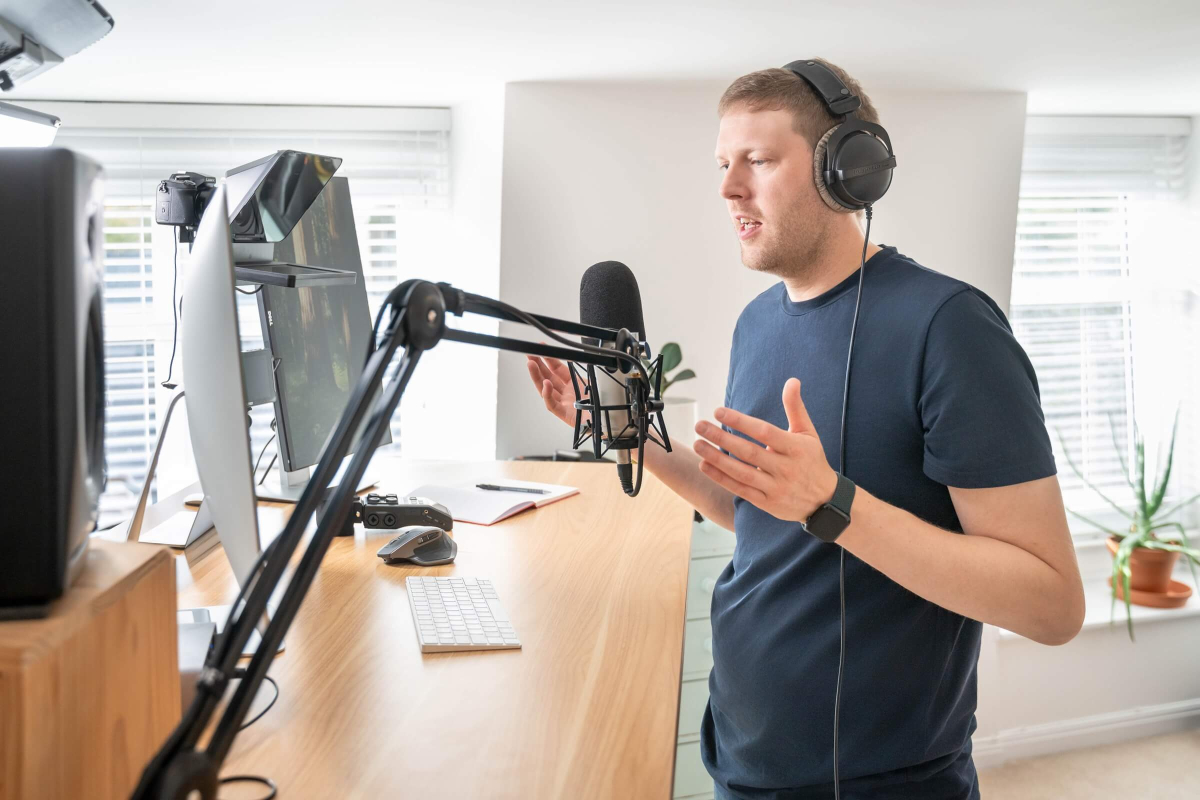
But here's what I learned from years working as a BBC Studio Director and now mixing podcasts: expensive equipment doesn't guarantee professional sound.
The myth:
- Expensive mics = professional sound
The reality (from BBC training and lived experience):
- Room acoustics matter more than microphone quality
- Mic technique (distance, angle, handling) transforms audio more than purchase price
- Editing precision (removing room tone, balancing levels, EQ) is where a good basis can be transformed into a genuinely professional sound
We've recorded clients on £60 USB mics in their home office that sounded better than broadcast studio setups because we knew how to position it correctly, modify their recording space and treat the raw recording to achieve a polished result. This ability comes from knowledge built recording thousands of hours in controlled environments, then adapting those principles to real-world conditions.
For business leaders, sonic quality isn't about audiophile perfectionism. It's about credibility. When you sound professional, people assume you are professional. When your audio is muddy, echoing, or inconsistent, it undermines everything you're trying to build. No matter how good your insights are, listeners get fatigued by poor sound quality and won’t stick around.
Have a look at my blog about how poor audio quality is a professional reputation killer.
Listener Psychology: What makes people stay
At the BBC, we operated on a simple principle: You have 30 seconds to earn the next 30 seconds.
What this means for business podcasts:
- Front-loading value (tell them why this matters in the first minute)
- Always make it about the listener. It’s for them, not about you.
- Varying pace (long thoughtful sections need short, punchy moments)
- Signposting ("Coming up, we'll discuss why this approach failed spectacularly...")
- Knowing when to end (finishing at 25 minutes when you have energy beats dragging to 40)
Remember: you're making something an audience needs to find interesting, enjoyable to listen to, and as easy to consume as flicking on the radio. That requires constant attention to the listener's experience, not just what you want to say.
The compound effect:
When listeners finish episodes, they come back. When they come back consistently, you build a platform. When you have a platform, you have influence. That's the long game, and it only works if you respect the listener's attention from minute one.
Why this matters for business leaders
“The reach of your pod Ben is extraordinary… this type of thing continues unabated!” This was an email we received from a former Rewilding the World guest referencing interest in his work and directly citing the podcast as the reason for initiating contact. This success cuts both ways as his episode is still one of the highest performing to date by download numbers.
That doesn't happen because you have a podcast. It happens because you have a podcast that people actually listen to, share, and remember.
And that level of quality doesn't come from buying better equipment. It comes from applying broadcast standards to every aspect of production. These standards were set and developed during Lizi and I’s 20 years of combined experience working in national newsrooms. Ben brings another decade of experience as a presenter on of the worlds largest commercial radio brands, Global.
Several of our clients have had success inviting representatives from global businesses to guest on their podcast as a way to build and strengthen relationships with strategic partners across the IT, software, sustainability and data security sectors.
The Question Isn't Whether You Should Podcast
Can you make a podcast yourself? Absolutely.
Can you make one that sounds like it belongs on Radio 4, holds attention from start to finish, and positions you as a serious voice in your industry?
That's where broadcast training matters. That's where 20 years of experience at the BBC, producing for shows like Jeremy Vine and BBC Breakfast that had to earn the attention of millions every single day, can't be replicated by watching YouTube tutorials.
I loved my time working with the Vine team at Radio 2 and the years I spent in live studios as a Studio Director at 5 live and Radio 4. Now we bring those same broadcast standards to business leaders who understand that if you're going to invest time and resources in a podcast, it should be built to the standards that actually earn attention and create lasting impact.
That's what we bring to the podcasts we build.
If you're considering a podcast that does more than just exist - one that actually earns attention and builds your authority - let's talk about what broadcast standards could mean for your project.
More Articles

Is your podcast title still relevant?
When was the last time you reviewed your older episodes and checked whether their titles are still relevant?

The strategic work that makes podcast marketing actually work
Marketing is a key part of that strategic process, but it isn't where you should start


Do this one thing to get people listening longer to your podcast
How to get your audience listening longer and why its important