287 edits you will never hear and why they matter

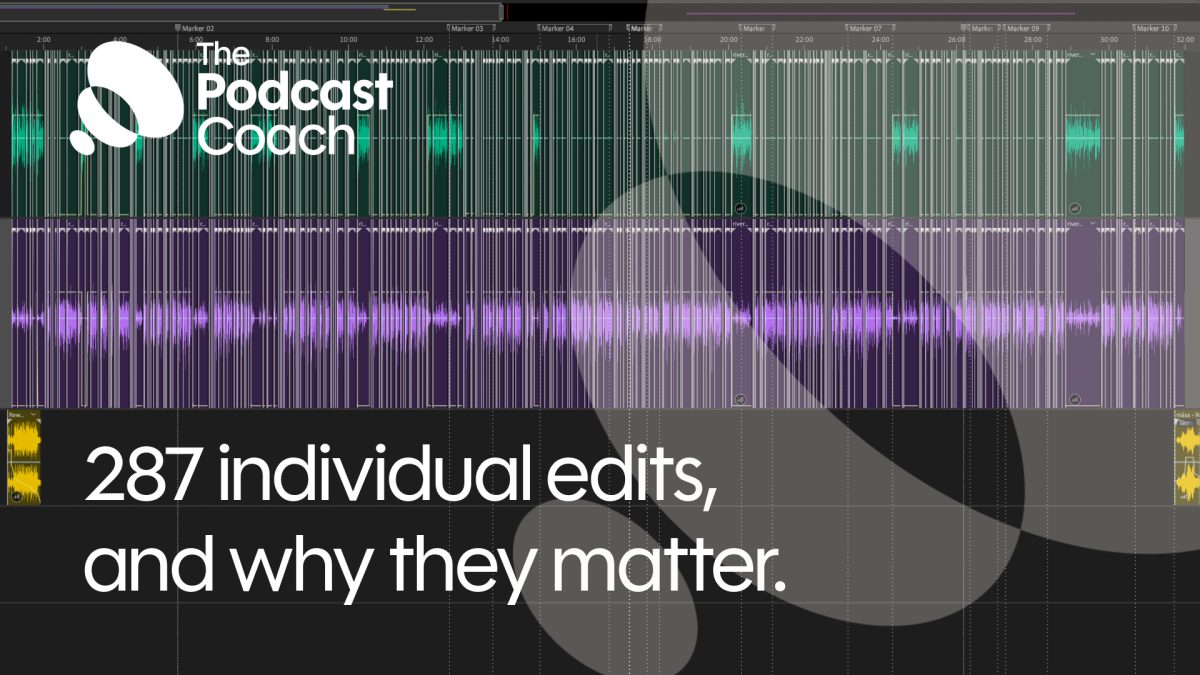
Why editing your podcast (properly) is crucial to success.
A former boss of mine at the BBC once told me that if he could hear an edit in my work, I needed to go back and do it again.
His high standards have stuck with me over the last 20 something years that I’ve been editing audio across BBC radio, podcasts and now as Head of Audio at The Podcast Coach.
Let me share an analogy I like to wheel out on client calls.
Drive a hundred miles on good tarmac and you won't remember a mile of it. Then you hit half a mile of crap road surface, the car starts rattling and you turn to whoever's next to you and say something about the state of the UK’s roads. You never once mentioned the preceding hundred miles of smooth surface. Nobody does, because smooth is usually invisible.
Podcast editing works the same way, and it's the reason this part of the post production job is so hard to explain to someone who's never done it.
From raw to polished in 287 cuts
I recently sat down with a raw 43-minute recording, two mics, an unscripted conversation, no retakes built in. The final mix is now ready to publish. It includes 287 individual edits.
Ums, errs and stumbles trimmed out. A retaken answer swapped for the better one. An interruption from the host's dog cut cleanly out. A tangent that went nowhere, gone. An answer that didn’t add sufficient value to compensate for its length, gone too.
You as a listener won’t hear any of it. As someone who is proud of my editing skills, I almost wish more people would notice but in reality that is the whole point of my work.
The thing that makes editing such an odd thing to sell is that if I've done my job well, there's nothing to point to. You can't play someone a clip and say "listen to how good this cut is," because a good cut sounds like nothing happened. I will admit I have been known to drop before and after samples of particularly tricky edits in our company WhatsApp group for some praise.
The only version of this work anyone actually notices is the bad version, the clumsy splice, the jump in sound level between voices, the moment where you can hear the room change between two adjacent sentences. A good editor's fingerprints are the absence of fingerprints.
Where AI actually helps, and where it doesn’t
AI tools are genuinely useful for parts of the post production process now. They can be a big help searching a transcript to find certain words or phrases, helping to assemble the key themes discussed as the basis for show notes. Some AI based tools are getting very good at helping to reduce background noise and clean up sub par audio. That's real, and it saves time.
What it doesn’t understand is that removing every single um, err or stumble actually misrepresents the speaker in a way which I think lacks authenticity. It won't hear that a pause is doing more work left in than it would if you cut it for momentum. It won’t replace a mispronounced word with the same one borrowed from elsewhere and spliced in seamlessly.
Those are judgment calls, built from listening to thousands of hours of other people's conversations. I’ve learned what makes the participants sound at their best while keeping a listener engaged versus what makes them reach for the skip button.
Underneath the judgment sits the craft an algorithm handles inconsistently at best. Whether that’s matching the room tone either side of a cut so the splice disappears, adjusting gain so a laugh doesn't clip or EQ-ing two people recorded in different rooms on different mics until they sound like they could be sitting across the same table. Get any of that wrong and the invisible work suddenly becomes very visible, for all the wrong reasons.
A simple experiment
Next time you're enjoying a podcast, try to catch a single edit as it happens. If you can't, someone did real work to make sure you couldn't. If you spot one, it could be an isolated slip (we all make mistakes) or it could be a sign something further up the chain. Perhaps something went awry during the recording, with the prep or with the equipment and the edit is just where it finally surfaced. It may well also be that AI had a heavy hand in editing the entire thing.
That's the strange economics of this job. The better the work, the less evidence there is that it happened at all. I’ve had a great number of conversations where a podcast host has told me how surprised they were to hear that an interview they remembered as not being their best work has actually turned out really rather well. That’s the magic of the edit and it’s not easy to see. Which is exactly why it's so easy for a business to look at a podcast budget and wonder why such a chunk of it is allocated to production. It's paying for the hundred miles you never noticed.
Editing mistakes and a platter of other production errors are just part of a much larger list of issues that can easily become switch off points for your listener. That’s why we built our podcast ‘Level Up’ solution so we can identify all the issues holding you back, as well as the things you’re doing well. We’ll guide you through how to make changes that’ll have a real and lasting impact on the quality of your podcast, the way the host and guests come across and ultimately how successful your show is.
More Articles

Why great podcast content starts with the angle
The most engaging podcasts develop from identifying the best angle for the story


Should your business start a podcast? A practical guide for leaders
A practical guide for leaders considering launching a podcast

Hosting solo vs co-hosting: what really changes?
How to host a podcast solo or with a co-host


Big agency expertise without the bureaucracy
Why our small, experienced team beats a big agency.
Why every business podcast needs a regular “listen back”
Creating a great podcast doesn't end when you stop recording
How to host a podcast without being a subject expert
The key role you play as a host is not to be a subject expert